
Patents were developed to encourage openness in the innovation space and to protect inventors. Unfortunately, startups frequently face abusive patent litigation by “patent trolls” — companies that take advantage of a broken software patent system and operate by collecting fees on software patent licenses, instead of making products and contributing to technological innovation. Meanwhile, new distribution technologies are making it easier for anyone to reach a broad audience, which is why we need balanced copyright laws that allow these new technologies and their creators to succeed.
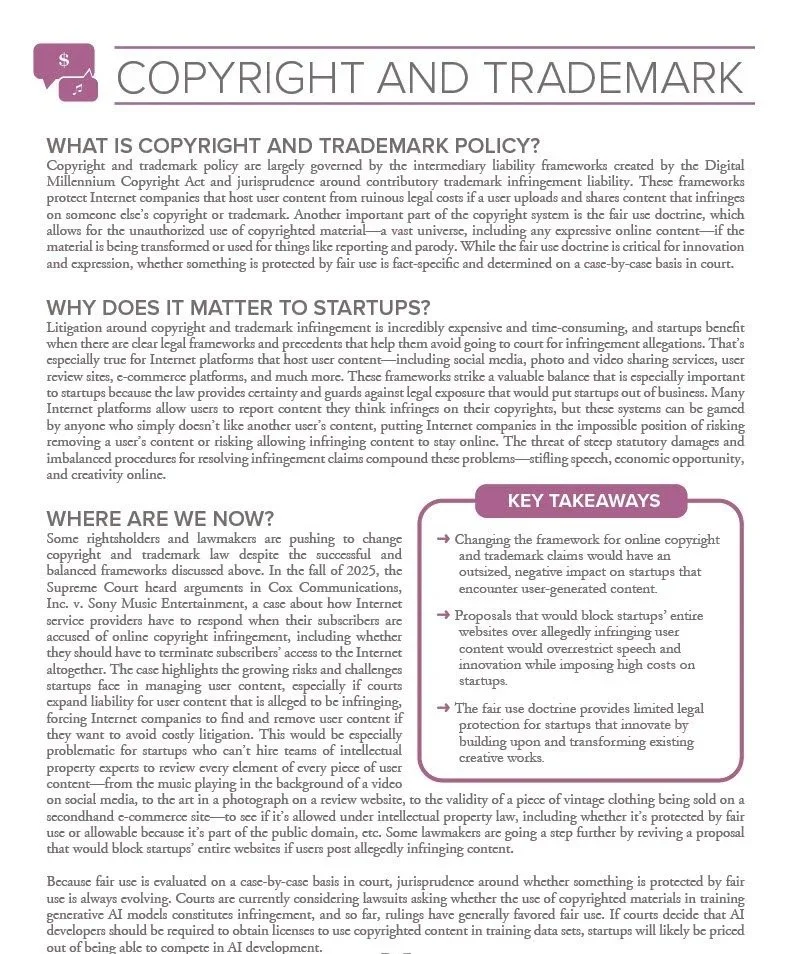
Copyright & Trademark Primer for Startups
Copyright & Trademark Primer for Policymakers
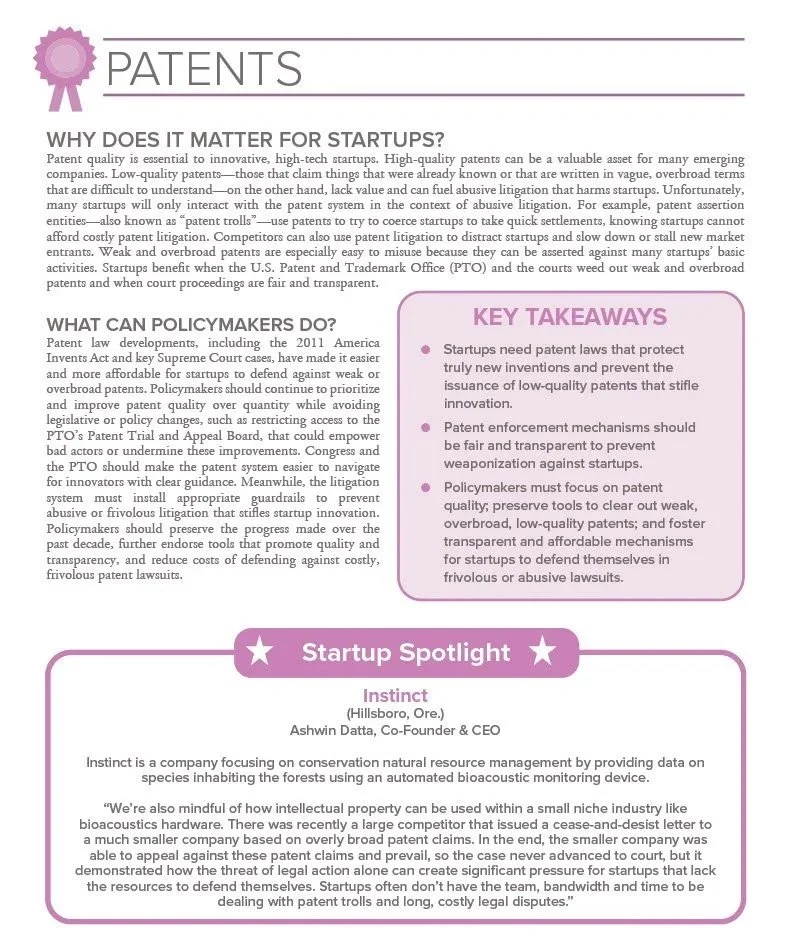
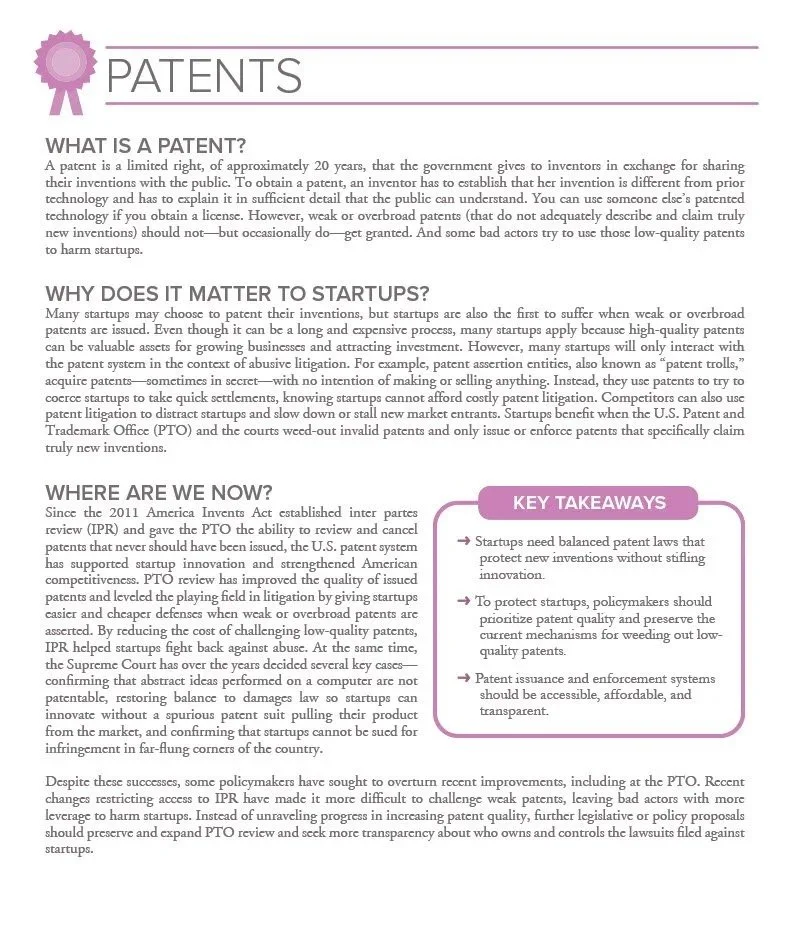
Startups & the U.S. Patent System: Prioritizing Quality and Balance to Promote Innovation
Supreme Court says Internet intermediaries not liable for user actions
Engine Statement regarding Supreme Court Decision in Cox Communications, Inc. v. Sony Music Entertainment
Today, Engine published the 2026 Startup Policy Agenda, highlighting the policy issues coming up this year that will impact startups.
Engine submitted comments to the U.S. Patent and Trademark Office opposing proposed changes that would restrict access to the Patent Trial and Appeal Board (PTAB).
The Trump administration is reportedly exploring a new framework for patent fees and valuation.
A key tool that promotes innovation by weeding out weak patents that can be weaponized against startups is being scaled back by federal policymakers.
Engine filed an amicus brief to the Supreme Court in Cox Communications, Inc. v. Sony Music Entertainment, arguing that Internet service providers and other intermediaries should not be held liable for users' alleged copyright infringment.
Engine released the 2025 Startup Policy Agenda showcasing how smart, thoughtful policy facilitates and encourages startup activity, leading to more innovation and more economic and job growth. The Agenda gives those working on policy an overview of the issues that are currently impacting—and the debates that stand to impact—startups.
Engine released the 2025 Startup Policy Playbook to give members of the startup ecosystem—founders, employees, investors, and support organizations—an overview of the policy conversations happening this year and how they can get involved in amplifying the startup voice. There’s lots to do, and lots to do better, and this playbook highlights why shaping innovation-friendly policies matters to startups.
The recent legislative and agency efforts directed at regulating digital replicas of individuals’ name, image, and likeness (NIL) have the potential to harm startups’ access to the artificial intelligence (AI) ecosystem and chill innovation.
Congressional Startup Day underscores importance of startups in policymaking
In a series of State Policy Updates, we are exploring how state initiatives are impacting the innovation happening in startup ecosystems across the country.
Senate advances Internet regulation rife with unintended consequences
Startups call for better access to capital for entrepreneurs of color
Startups to face hiring challenges following independent contractor rule
The Big Story: Over 65 startups call for uniform federal privacy law. This week, startups are calling on Congress to pass a federal privacy law that takes the startup ecosystem into account. A coalition of startups and support organizations across 26 states sent a letter to Congress urging lawmakers to pass a law that creates uniformity, promotes clarity, limits bad faith litigation, accounts for the resources of startups, and recognizes the interconnectedness of the startup ecosystem. The letter comes as states continue to enact their own unique data privacy laws, and as a Congressional committee explored the problems posed by a sectoral federal privacy landscape in a hearing this week.
The Big Story: Section 230, privacy, encryption in crosshairs at kids safety hearing. The Senate Judiciary Committee held a hearing Tuesday on protecting children’s safety online, where lawmakers suggested changes to several issues important to startups, like Section 230, data privacy, and encryption. The wide-ranging proposals appear conceived with the largest tech companies in mind, but they would affect all Internet companies, especially startups. The hearing comes amid efforts from policymakers at all levels of government aimed at safeguarding young Internet users that could carry unintended negative consequences for startups without necessarily protecting children.
Bad actors are constantly looking to trick unsuspecting startups into unnecessarily giving up their already-limited resources. One scam gaining in popularity is to impersonate government officials and ask startups for payment to “renew” their existing trademarks, and it demonstrates how intellectual property systems can be weaponized against startups.
You might not realize it, but whether you’re a startup founder, a digital entrepreneur, or a casual technology and Internet user—what the U.S. Patent and Trademark Office (USPTO) does impacts you and the agency needs to be listening to you. That’s why Engine filed comments this week on USPTO’s draft strategic plan, suggesting ways the agency could improve its plans to support all U.S. innovators, creators, and entrepreneurs.
Startup founders are busy people. They’re running businesses, managing small teams, raising funds, and doing the actual work of building new and innovative things. It’s no wonder they’re not also constantly tracking and engaging in policymaking in D.C.
Engine's Startup Policy Agenda for 2023 highlights the voices of those startup companies, investors, and support organizations as they discuss in their own words the obstacles they face and the ways policies have helped and hurt them. We hope it serves as a high-level overview of the issues we hear about from startups every day and a jumping off point for policymakers looking to support the technology industry's small businesses.
The Big Story: Engine releases report on the role of acquisitions in the startup ecosystem. Engine, in partnership with Startup Genome, released a new report this week examining the role exits play in the startup ecosystem, highlighting the importance of exits via acquisition, and emphasizing the experience of founders that have had their companies acquired. The report—“Exits, Investment, and the Startup Experience: the role of acquisitions in the startup ecosystem”—should equip policymakers with a solid foundation from which they can advance pro-innovative policies that startups need to thrive.